Seawolf AI Innovation: Using AI as a Tool for Passion Projects
April 24th, 2025
As AI becomes more and more integrated into our everyday lives, it is inevitable that it will be an essential part of how we educate moving forward. Amidst this rapidly changing digital landscape, Pacifica is leading conversations and initiatives on how to incorporate AI as a resource for innovation, instead of a shortcut to learning.
Last year, we offered a one-semester course on ‘AI and Virtue.’ This year, some students are diving into the possibilities of Generative AI for their extracurricular passion projects. Generative AI is defined as “a type of artificial intelligence that creates new content by learning patterns from existing data.” Steve Eno, Pacifica math teacher, is leading the charge in guiding these students as they learn how to use AI as a tool for their projects. Follow our ‘Seawolf AI Innovation’ series over the next few weeks to see how Seawolves are teaming up with AI for good.
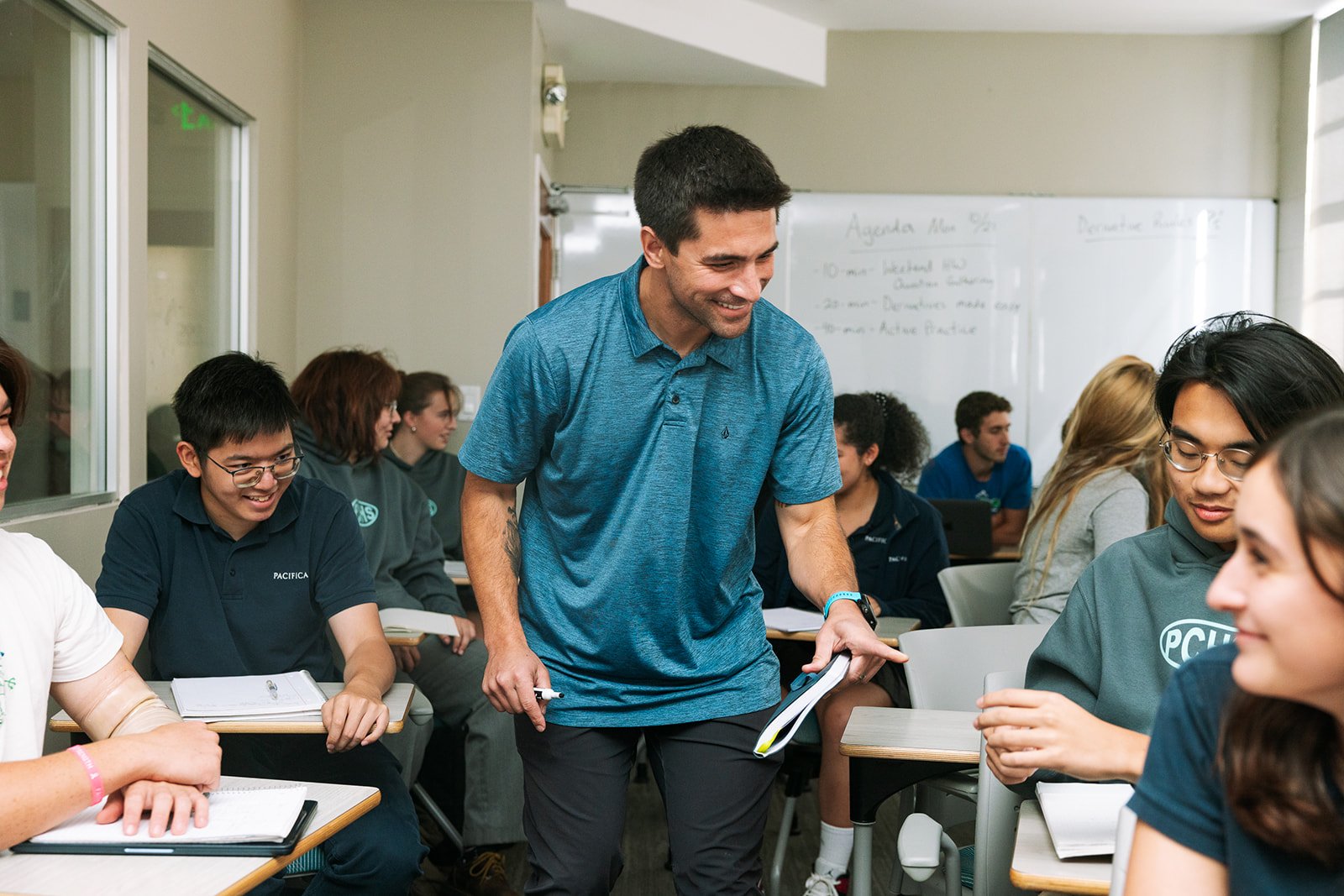
Mr. Eno seeks to help students embrace AI as a way to remove useless friction in learning, while not using it to take away any struggle that is necessary to learning.
“High school students are still building their foundational knowledge and skills,” says Eno. “If AI replaces those fundamental knowledge and skills, then students lose the ability to realize how to uniquely apply fundamentals to novel situations. Broad generative AI like ChatGPT should be kept out of the classroom, while target AI tools like code generators and interest connectors can enhance the experience for students and teachers.”
He expands on this point by saying that when students use generative AI to create connections between their personal interests and content they are learning in the classroom, it increases their curiosity and ability to persevere through challenges. In Mr. Eno’s classroom, students use Project Leo, the AI platform designed by Eno, to align their interests with course content and to capture their thinking through reflections as a check for mastery.
 For guidance on extracurricular passion projects, he advises students on how to use Replit Agent, which allows students to to build web applications no matter their level of computer science knowledge. Generative AI helps students brainstorm ideas in a much broader and deeper way than their limited worldview would usually allow, giving depth and novelty to existing ideas. It also aids in building their projects to viability much faster than would be possible without AI, expanding their potential to share a fully functional project with the world.
Some may be skeptical of introducing AI into the classroom, which Mr. Eno reassures is a valid concern, and that it must be adequately explored, not ignored. He views AI as a way to further genuine connection with his students.
“Generative AI is highly customizable, but it takes time to experiment and see how exactly it can benefit the learning process,” says Eno. “I believe that our job as teachers is to unlock the unique skills and interests of our students through human connection. Generative AI can help us get to know students better, but only if we’re using it in highly targeted ways. If we use AI to reduce the planning or assessment time, we can spend more time being present with our students and having fun exploring the content with them.”
From the student side, he believes that Generative AI should be used to help magnify their unique interests and skills. While immediately turning to ChatGPT when faced with a challenge will stunt student creativity, using generative AI as a multiplier for their original ideas will allow them to expand upon great ideas quicker than ever before.
“I like the saying, Generative AI won’t take your job, but a person who knows how to use Generative AI will.”

Categories
Recent Articles
10 Reasons Content Box
10 Reasons to Choose Pacifica
 Inquire
 Apply
Apply Give
Give